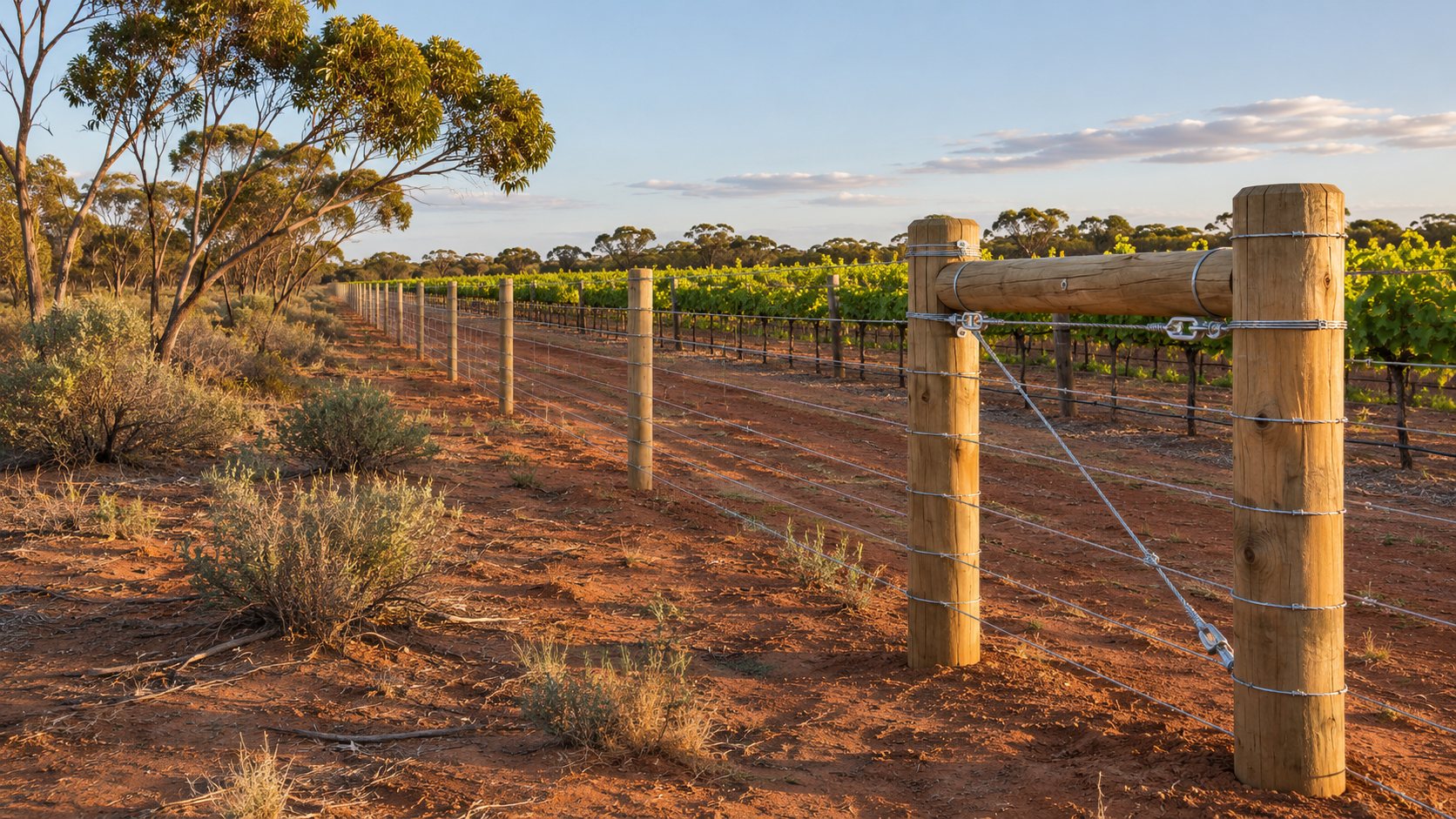
Rural fencing in Mildura, Sunraysia and Wentworth Shire
Rural fencing in Mildura and Sunraysia for farm, stock, vineyard, orchard, horse and exclusion work, passed to local fencing contractors on both sides of the Murray.
A fence on one side of the river sits under a different Act from a fence on the other. Know which side yours is on, and ask which licence or registration the contractor holds.
Tell us where the fence is and what it has to do
The town, which side of the Murray, and what the fence must hold or keep out. A photo of the fence line and a rough length are enough to begin. Your enquiry is passed to a local contractor. This site does not build fences or quote.
Request a quote
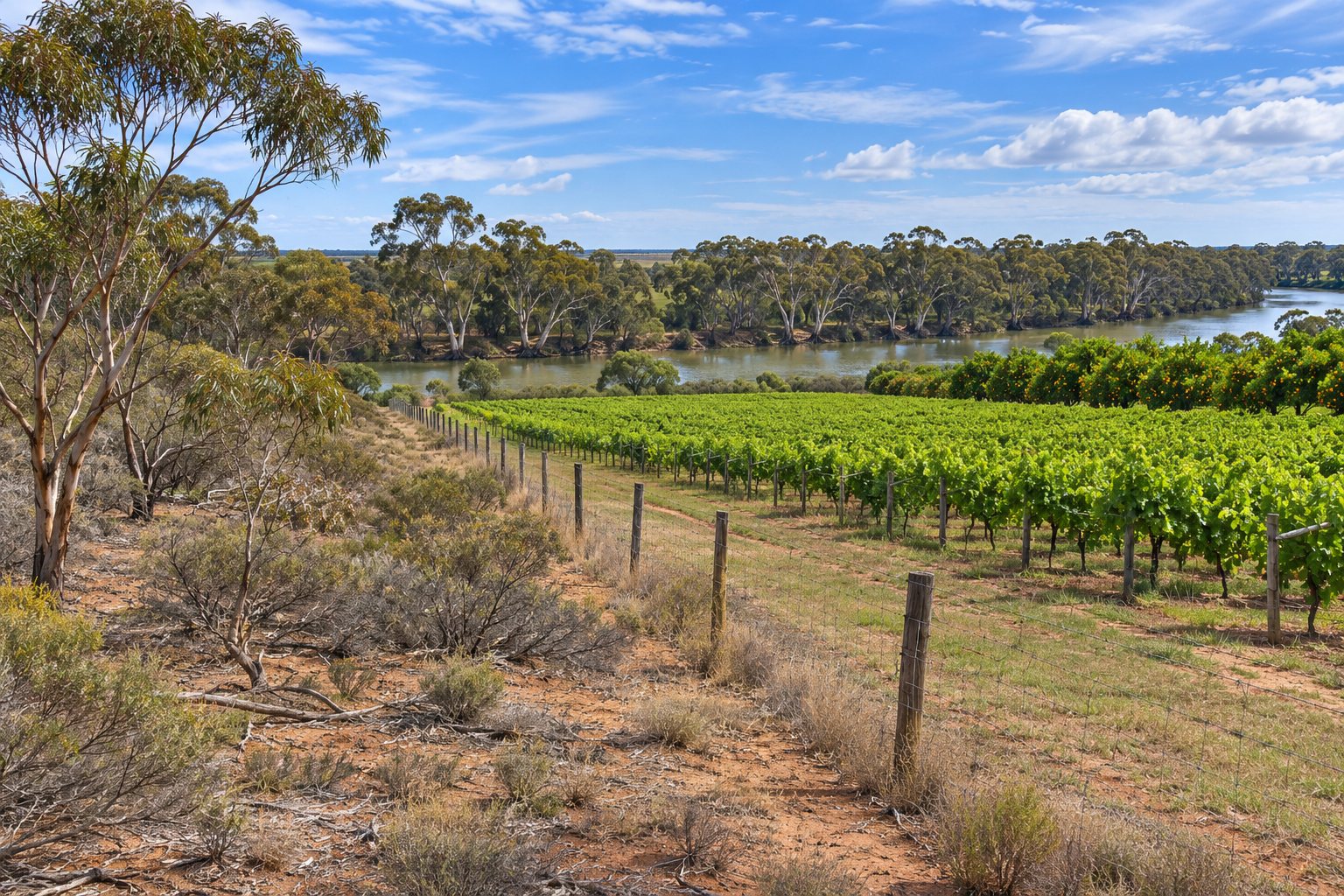
Irrigated vines beside dry mallee, and a river that is also a state border.
Irrigated horticulture runs along the Murray, with dryland grain and sheep country beyond. At the 2021 Census grape growing was a top-five industry in Red Cliffs (4.8 per cent of employed people), Irymple (4.7), Merbein (3.5), Euston (7.2) and Wentworth Shire (2.7), and 17.1 per cent in Robinvale (241 people). Other grain growing was 10.8 per cent at Ouyen, and sheep farming 8.2 per cent in the Wentworth-Balranald region. Separate houses ran from 77.4 per cent of dwellings in Mildura North to 95.0 in Ouyen.
The Murray is the state border, and the Mildura and Buronga urban area spans it: Buronga is in New South Wales. Wikipedia, a secondary source, puts the border along the top of the southern, Victorian, bank (Murray River article). Survey agencies agreed "the precise line of the border" at Mildura in September 2022, with formal survey and marking still to follow (survey update). The Act that applies is the one for the state where the fence is.
No source we found says what either Act does for a fence along or across the river, or between a Victorian owner and a New South Wales owner. Ask the regulator or a solicitor. Fencing near the Murray, in full
What to settle before you book
- Which side of the MurrayThe Victorian side is under the Fences Act 1968, the New South Wales side under the Dividing Fences Act 1991.
- Boundary or internal fenceThe boundary Acts are about fences between neighbours' lands. An internal fence is between you and the contractor.
- Who the neighbour isA private owner, Crown land, a council reserve or a water authority. See the Victorian and New South Wales pages.
- What the fence must holdSheep, cattle, horses, rabbits or kangaroos. See the stock, horse and exclusion pages.
- GroundSand or limestone. Ask whether the quote allows for drilling and how rock is charged.
- Access and seasonAsk how harvest and pruning affect access to the block, and check current CFA rules for Total Fire Ban days.
- River, channel or flood areaA flood overlay can mean a council permit on the Victorian side of the Murray. Ask the council on either side.
- A written quote and the licence heldItemised in writing, naming the licence or registration.
Rural fencing services in Mildura, Sunraysia and Wentworth Shire
Farm & stock fencing
Post and wire, ringlock and paddock fencing for sheep and cattle: the options, how strainers and gates work and what a written quote should cover.
Read more →Vineyard, orchard & boundary fencing
Perimeter and boundary fencing for irrigated blocks in Sunraysia: gates, channel and river edges, and what to ask a contractor.
Read more →Rabbit, kangaroo & emu exclusion
How exclusion fencing differs from stock fencing, the published designs we found and what to confirm before you order.
Read more →Horse & lifestyle block fencing
Wire, mesh, rail and electric options for horse paddocks and rural-residential blocks, and the safety points to settle first.
Read more →What affects the cost
The factors that move a rural fencing quote on Mildura-area land, and a checklist for comparing written quotes line by line.
Read more →Two Acts, one for each side of the Murray
Who pays for a boundary fence depends on the side of the Murray. Each cell comes from its own source, in the version we found.
| Point | Victorian side of the Murray (Fences Act 1968) | New South Wales side of the Murray (Dividing Fences Act 1991) |
|---|---|---|
| Equal share | Owners are liable to contribute in equal proportions to fencing works, section 7 (Fences Act text). | Adjoining owners are liable to contribute in equal proportions to the carrying out of fencing work, section 7 (Dividing Fences Act text). |
| After a notice | The neighbour has 30 days from receipt to respond (Justice Victoria). | Either owner can apply for Fencing Orders if there is no agreement after a month (Legal Aid NSW). |
| Crown and public land | Section 31 says the Act shall not apply to any unalienated Crown lands (Fences Act text). | Section 25 says the Act imposes no liability and confers no rights for dividing fences on listed Crown and public land (Dividing Fences Act text). |
| A rural fence | "For rural properties, a sufficient dividing fence might be a wire and post fence" (Justice Victoria). | No rural statement found. What is sufficient depends on the circumstances (Legal Aid NSW). |
See the Victorian page and the New South Wales page.
Licensing: what the regulator pages say, and where they stop
The regulator pages we found do not say whether farm, stock, vineyard or exclusion fencing needs a contractor licence or registration, in either state. Licensing depends on the value and type of work. Ask the contractor which licence or registration they hold, check it with the regulator for the side of the Murray where the fence is, and ask the regulator if you are unsure.
On the New South Wales side of the Murray, the Building Commission NSW fencing page defines fencing as "putting up fences and gates within or on residential property boundary lines". If the work counts as residential building work (the pages do not say whether a rural fence does), a contractor licence is needed for work valued at more than $5,000 including GST. On the Victorian side of the Murray, Consumer Affairs Victoria says registration is needed for domestic building work where the contract is worth more than $10,000. Whether a rural fence is domestic building work is not stated.
A licensee working across the border must notify the other state's regulator first (Building and Plumbing Commission). Licences, contracts and quotes for both states
What this site cannot do
This site cannot build, quote, inspect or sign off a fence. It cannot tell you which licence or registration a contractor needs, because the regulator pages we found do not say, or confirm that any contractor holds one. It cannot say where the border falls on your block, serve a Fencing Notice, decide a neighbour dispute or issue a permit. Those belong to the contractor, the regulator, the council, a solicitor and the courts or tribunal on each side of the Murray.
Check the current rules before you rely on this
This page describes the boundary fence Acts on each side of the Murray and what the regulator pages say about contractor licensing for fences. It describes the rules in general terms as they stood in November 2026. Standards, forms, thresholds and fines change.
The authoritative sources are NSW Government, fencing work (Building Commission NSW), Consumer Affairs Victoria, becoming a registered building practitioner, Justice Victoria, fences: your rights and obligations, NCAT, dividing fences and Building and Plumbing Commission Victoria, automatic mutual recognition. Where anything here differs from those sources, they are right and we are not.
We are not fencing contractors, builders, regulators or lawyers. For what applies to your fence, ask the contractor which licence or registration they hold, then ask the regulator for the side of the Murray where the fence is: Building Commission NSW (13 27 00) for New South Wales, the Building and Plumbing Commission for Victoria.
Accurate at the time of writing, November 2026. Always check the source before relying on it.
Towns and districts covered:
What a rural fencing quote should itemise
This site publishes no prices. Make each written quote spell out the same things, so they can be compared line by line.
| Line | What to ask |
|---|---|
| Fence length and line | Who locates the line, and from what. |
| End assemblies and gates | How many, of what type, and where. |
| Posts | Timber or steel, the treatment or galvanising, the spacing. |
| Wire | Plain, barbed or netting, the gauge, the coating. |
| Straining and tying off | How, and to what tension. |
| Rock drilling | Whether it is allowed for, and how rock is charged. |
| Vegetation clearing | Who clears, how wide, and whether a permit applies. |
| Permits | Which apply, who applies and who pays. |
| Removal of the old fence | Taken away or left, and who pays. |
| Electric parts and earthing | Energiser, insulators and earth stakes, if electric. |
| Licence or registration | Which one, for which side of the river. |
| Neighbour notice | Who serves any Fencing Notice. |
The cost guide goes through each factor, and the contact page lists what to send.
Things landholders on both sides of the Murray ask
Who pays for a boundary fence on a farm?
In the usual case neighbours share the cost equally. On the Victorian side of the Murray, the Fences Act 1968 says owners are liable to contribute in equal proportions to fencing works, and Justice Victoria says costs are shared equally. On the New South Wales side of the Murray, the Dividing Fences Act 1991 says adjoining owners are liable to contribute in equal proportions, and Legal Aid NSW says neighbours generally share. Crown and public land are treated differently on each side.
How long do I wait after serving a fencing notice?
On the Victorian side of the Murray, Justice Victoria says the neighbour has 30 days from receiving the Fencing Notice to respond. On the New South Wales side of the Murray, Legal Aid NSW says either owner can apply for Fencing Orders if there is no agreement after a month has passed, and NCAT says the notice must be served at least one month before you apply. These are two different Acts, so read the page for your side.
Do rural fencing contractors need a licence in Victoria or NSW?
The regulator pages we found do not say whether farm, stock, vineyard or exclusion fencing needs a contractor licence or registration, in either state. Licensing depends on the value and type of work. Ask the contractor which licence or registration they hold, check it with the regulator for the side of the Murray where the fence is, and ask the regulator if you are unsure.
What is a standard rural fence?
On the Victorian side of the Murray, Justice Victoria says the law does not set a height or material, and that for rural properties a sufficient dividing fence might be a wire and post fence. On the New South Wales side of the Murray we found no rural statement. Legal Aid NSW says what is sufficient depends on the existing fence, other fences in the area, how the land on each side is used, council requirements and privacy.
How much does rural fencing cost per metre?
It depends on the fence type, the length and terrain, access, the ground, the number of strainer assemblies and gates, approvals and, for a boundary fence, shared items such as clearing and removing the old fence. This site publishes no per-metre figure, because one number would be wrong for most blocks. Ask for itemised written quotes and compare them line by line using the cost guide.
How long does a rural fence last?
We found no neutral source that gives a lifespan figure for a rural fence, so this site publishes none. The sources do describe what varies: the post material and treatment, the wire coating, how the ends are braced and the ground. Ask the contractor what they propose for each, and what the written warranty terms are and who gives them.
Do I need a permit to fence near the Murray or in a flood area?
It depends on which side of the river the fence is. On the Victorian side of the Murray, flood overlays can require a council planning permit for fences, and Mildura Rural City Council says fences may need a building permit, so ask its building department. On the New South Wales side of the Murray, a statewide exempt development fact sheet lists flood-control lots among places where exempt fences are not allowed, so check its exact scope and ask Wentworth Shire Council.
Can fencing work go ahead on a total fire ban day?
The Victorian documents we found, both old, say welding and grinding in the open are restricted on Total Fire Ban days, so on the Victorian side of the Murray check current CFA rules before any work that uses grinders or welders. We found no New South Wales Rural Fire Service statement, so on the New South Wales side of the Murray ask the RFS. Ask the contractor how they plan around ban days.
Send a town, a side of the river and a photo
The town, which side of the Murray, what the fence must hold or keep out, and roughly how long it is.