How long does a rural fence last? What we can and cannot say
No neutral source we found gives a figure for how long a rural fence lasts in Sunraysia or anywhere else. The statements that do exist come from suppliers and marketing material, they are about their own products, and we could not verify them, so this page quotes none. What the sources do give is a short list of things that bear on whether a fence holds up: the post material and its treatment, the wire coating, the design of the ends, and the ground. Those are the questions to put to a contractor, and they are the ones this page works through.
That is a deliberate gap and not an oversight. A number would sound like an answer, and it would be a guess dressed as one. Cost is a separate question, covered in the cost and quote guide.
Timber, steel and galvanising: what a supplier handbook says
The most useful source we read for materials is one supplier's fencing handbook, which is a supplier guide and gives no heights, spacings or costs. It makes a handful of plain statements about materials, set out below with what each leaves unsaid. If you are searching for timber vs steel posts, note that the handbook does not rank them: it describes where each suits.
| Material | What the handbook says | What it does not say |
|---|---|---|
| Treated timber posts | Treated timber is resistant to rot and termites. | How resistant, for how long, or in which soil |
| Steel posts | Steel suits areas with a high fire risk, and it corrodes in coastal areas and in acidic soils. | Whether Sunraysia soils fall in either group |
| Galvanised steel and wire | Galvanised lasts longer. | Longer than what, or by how much |
| Plain wire | Options are standard or heavy galvanised, and low or high tensile. | How the options compare in the field |
The gaps in the right-hand column are the useful part. A contractor who recommends one material over another should be able to say why for your block, and a written quote should name the post type, the treatment or coating, and the wire.
Where the load sits: the ends of the fence
Wire on a rural fence is kept under tension between braced end posts, with smaller posts between to hold the wire spaced (Wikipedia, a secondary source). The ends are where that tension is held, which is why the handbook gives them detail. It places strainer assemblies at fence ends, gateways, corners, direction changes, hilltops and gully bottoms. It says angle stays suit firm ground and box assemblies suit soft ground, that suspension fences with droppers suit flat country with posts further apart, and that wire should be strained to the manufacturer's tension, measured with a tension tool.
So the design of the end assemblies, the ground they sit in, and whether the wire was strained to a measured tension are all things you can ask about. They are also line items on the farm and stock fencing quote. The handbook does not say how any of these affect how long a fence lasts, and neither do we.
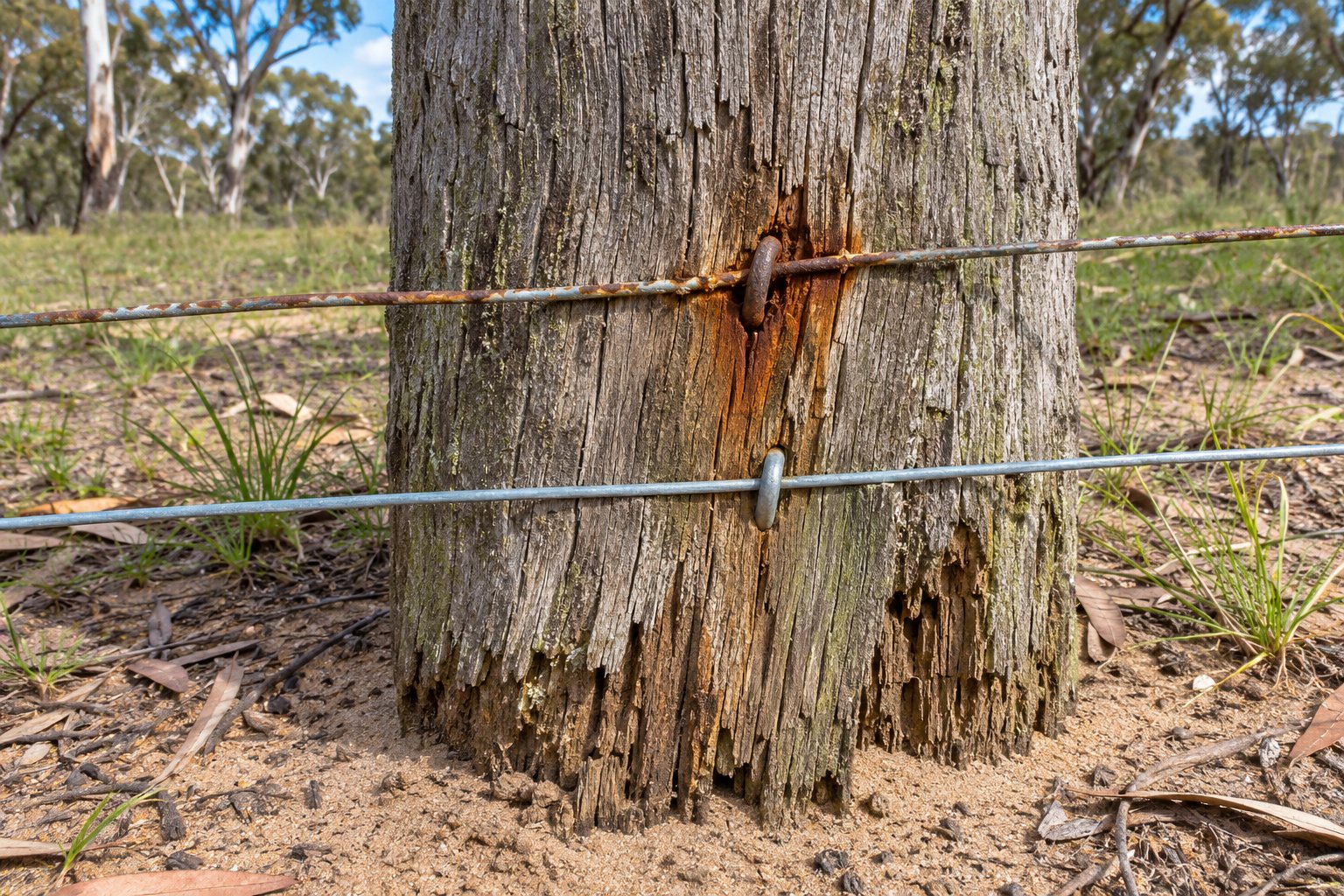
The ground in the Mildura district
The Victorian soil survey for the Mallee describes soils ranging from sands to clays (Mallee Calcarosols). Sands occur mainly on east-west dunes and are very prone to wind erosion. Heavier soils can become hardsetting. Lime is common in the subsoil, sometimes in nodules or as blocks, and in stony soils a solid limestone layer sits within 30 cm of the surface. The page does not discuss posts or fences, so we do not say what any of this does to a post or a strainer. Ask the contractor what they have seen on similar ground and how the posts will be set. The hard ground guide goes through the soil descriptions.
Flood-prone ground and wire mesh
Flooding is a different kind of test for a fence. Guidelines from two other catchment authorities, North Central and Wimmera, which are other regions' guidelines and not the Mallee's (North Central CMA), say: "We advise against installing wire mesh or rabbit proof (netting) fences in flood prone areas", and describe flood-friendly types with widely spaced posts and few wires. For Mildura, Victoria SES says the last significant riverine flood was in 1956 and flash flooding is the higher risk; the Murray page has the details. If your fence is near the river or a low area, ask the contractor whether the fence type suits flood-prone ground.
Electric parts and boundary damage
An electric fence adds an energiser, insulators and earth stakes, and the electric fence guide covers them. No source we read says how long those parts last. For a boundary fence, damage is a different matter from wear. On the Victorian side of the Murray, Justice Victoria says damage caused by a neighbour is that neighbour's cost; the summary we read does not discuss wear. The New South Wales side of the Murray has its own Act, and the New South Wales page covers it separately.
Questions to ask about durability and warranty
- What are the posts? Timber or steel, and the treatment or coating, in writing.
- What is the wire? Type, gauge and coating.
- How are the ends built? Angle stays or box assemblies, and why that suits your ground.
- How is the wire strained? To the manufacturer's tension, measured with a tension tool.
- What is warranted, by whom? Ask for the written warranty terms, who gives them (the contractor, a manufacturer or both), and whether they cover materials, workmanship or both.
- What checks do they suggest? Ask what they would look at first when inspecting the fence later.
Any statement about how long a fence will last is only as good as the written terms behind it. Ask for those terms, and keep them with the quote. Then send your town and a photo of the fence line and the enquiry goes to a local contractor.
What this page cannot do
This page cannot tell you how long your fence will last, and it will not pretend to. It cannot rank timber against steel, because the sources we read do not. It cannot say what Mildura-area soils do to posts, because the soil survey does not address fences. It cannot judge a supplier's or contractor's claims, and we have not repeated any of them. We are a referral service: we pass your enquiry to local contractors, who decide what suits your block and who give any warranty in writing.
Check the current rules before you rely on this
This page describes what the sources we found say about the materials, ends and ground that affect how a rural fence holds up around Mildura. It describes the rules in general terms as they stood in November 2026. Standards, forms, thresholds and fines change.
The authoritative sources are Rural supplier's fencing handbook (undated; supplier guide, no heights, spacings or costs), Victorian Resources Online, Mallee Calcarosols, North Central CMA, fencing guidelines for flood-prone areas (2020; another region's guideline) and Justice Victoria, fences: your rights and obligations. Where anything here differs from those sources, they are right and we are not.
We are not fencing contractors, builders, regulators or lawyers. For what applies to your fence, ask the contractor which licence or registration they hold, then ask the regulator for the side of the Murray where the fence is: Building Commission NSW (13 27 00) for New South Wales, the Building and Plumbing Commission for Victoria.
Accurate at the time of writing, November 2026. Always check the source before relying on it.