Rabbit proof fencing near Mildura: what exclusion fencing is
A stock fence keeps animals in. An exclusion fence keeps a named animal out, and that changes the design. In the designs we found, rabbit proof fencing is mostly about fine mesh and work at ground level, and kangaroo fencing is mostly about height. This page sets out the published designs we found, says where they stop and lists what to confirm before you order. Your enquiry is passed to a local contractor, who does the work and is responsible for holding any licence or registration that applies.
Two things first. No emu fence specification was found, and no source we read shows kangaroo or emu damage in Sunraysia. This page is a guide to published designs, not a claim that these animals are a problem on your block. If your problem is the edge of an irrigated block rather than a named animal, the boundary page is the better start.
The published designs we found
None of these sources is about Sunraysia, and each should be read as an example of how a design is written, not as a specification for your block. They are attributed here because the figures differ between them.
| Source | Animal | What it gives |
|---|---|---|
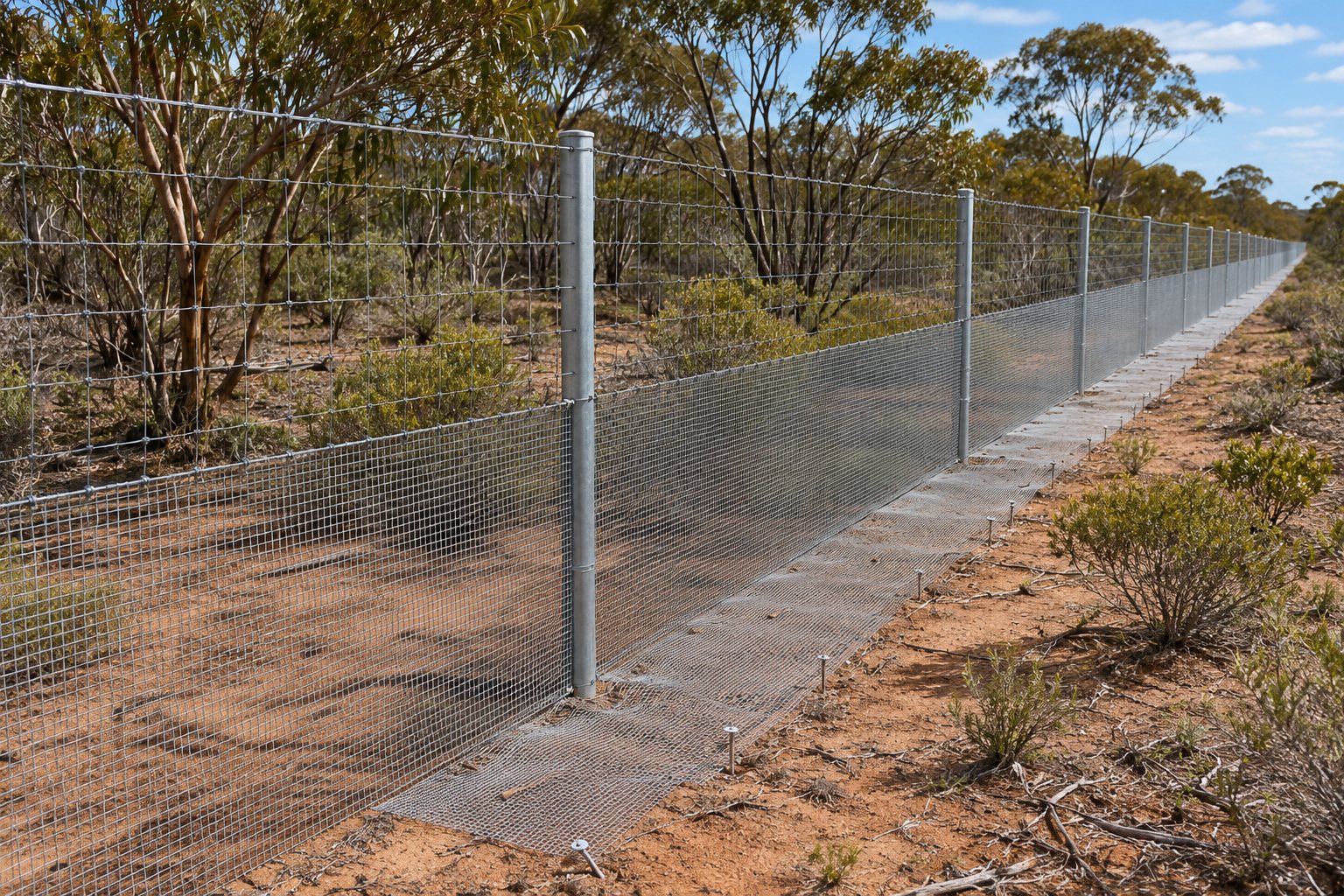
| Another Victorian council's exclusion sheet, deer-focused (council fact sheet) | Rabbits | Wire mesh buried or pegged in an outward-facing skirt, rising to about 90 cm. |
| The same council sheet | Kangaroos and deer | Kangaroos about 1.8 m tall with strong chain mesh. Deer mesh 1.5 to 1.9 m. The sheet excludes stock, waterway and predator fences. |
| A pest-animal management page on deer fences (deer exclusion page) | Deer, also wild dogs, feral pigs and kangaroos | A minimum height of 1.9 m, mesh netting written "17/190/15", posts a maximum of 10 m apart, an outrigger electric wire 20 to 60 cm above ground, and a 30 cm apron described as desirable, with posts closer, about 5 m, when an apron is used. It says these specifications also stop wild dogs, feral pigs and kangaroos. It does not cover rabbits or foxes. |
| One government design (a Queensland Government rabbit fence design) | Rabbits | Netting written "90 x 4 x 1.4" with its top 960 mm above ground, foot netting buried a minimum of 150 mm, posts 4 m apart, strainers 100 m apart, wooden posts 600 mm in the ground and strainers 900 mm, a top barbed wire at 1220 mm and a bottom plain wire 150 mm above ground. |
Rabbits: the skirt or buried netting
Two of the sources deal with rabbits, and they describe it differently. The council sheet describes mesh buried or pegged in an outward-facing skirt. The government design describes foot netting buried a minimum of 150 mm. Both put the work at ground level. Ask the contractor whether the skirt is buried or pegged, how far it extends, and what it is made from, and whether the quote names the mesh size in the same height, mesh and wire format as the government design. Skirts are costly to remove, according to the council sheet, so settle the design before the trench is dug.
Kangaroos and emus: where the sources stop
For kangaroos the sources give a height. The council sheet says about 1.8 m tall with strong chain mesh, and the deer page says its 1.9 m specification also stops kangaroos. Both are deer-focused and neither is about Sunraysia. For emus we found nothing: no emu specification, no height, no mesh size. We will not guess one. If emus are the animal, ask the contractor what they have built for them and on what basis, and ask your council or a pest-animal authority whether a published design exists.
Floods, the river and the rules
Guidance from catchment authorities in other regions advises against wire mesh or rabbit-proof netting fences in flood-prone areas (one catchment authority's guideline and another's). These are other regions' guidelines and they are not Mildura rules, but they are the kind of caution to raise with a contractor if the block is near the river or a flood overlay.
On the Victorian side of the Murray, a flood overlay can mean a council planning permit for fences, so ask Mildura Rural City Council. On the New South Wales side of the Murray, a statewide fact sheet lists flood-control lots among the places where exempt fences are not allowed, and its exact scope needs checking, so ask Wentworth Shire Council. The Murray page sets out both, and each side stays separate.
What makes an exclusion fence cost more
The council sheet says large fences cost more, and that consolidated fences are more cost-effective than long, hard-to-see enclosures. Length, height, the mesh and the ground-level work all matter, and the ground matters too: the soil survey describes a limestone layer within 30 cm of the surface in stony soils, so ask whether a buried skirt allows for drilling. We publish no prices. The cost guide lists the factors and the checklist for comparing written quotes.
What to confirm before you order
- The animal and the evidence. Which animal, and what you have seen it do. A design for rabbits is not a design for kangaroos.
- The design source. Which published design the contractor is following, and where it comes from.
- Height, mesh and skirt. Height above ground, mesh size and wire gauge, and whether the skirt is buried or pegged.
- Gates and crossings. Where vehicles and stock cross, and how the gate is sealed at ground level.
- Permits and the side of the Murray. Whether a permit applies, and under which council.
- The licence or registration. The regulator pages we found do not say whether exclusion fencing needs one. Ask which the contractor holds and check it with the regulator for the side of the Murray where the fence is. See the licensing page.
Stock fencing is on the farm and stock page and horse paddocks on the horse and lifestyle page.
What this page cannot do
It cannot specify a rabbit, kangaroo or emu fence for your block. The designs above come from another council, a deer-focused page and one government design, and none was written for Sunraysia. It cannot tell you that rabbits, kangaroos or emus are damaging crops here, because no source we found shows that. It cannot give a price, say what licence or registration a contractor needs, or approve a permit. Ask the contractor what design they propose and why, and ask the council and the regulator about your block.
Check the current rules before you rely on this
This page describes how published exclusion fence designs for rabbits and kangaroos are written and what they leave out, with no specification for Sunraysia. It describes the rules in general terms as they stood in November 2026. Standards, forms, thresholds and fines change.
The authoritative sources are Nillumbik Shire Council, exclusion fencing fact sheet (another council; deer-focused), PestSmart, exclusion fencing (deer-focused), Queensland Government, rabbit fence design, North Central CMA, fencing guidelines for flood-prone areas (2020; another region's guideline) and Wimmera CMA, fencing guidelines (17 December 2024; another region's guideline). Where anything here differs from those sources, they are right and we are not.
We are not fencing contractors, builders, regulators or lawyers. For what applies to your fence, ask the contractor which licence or registration they hold, then ask the regulator for the side of the Murray where the fence is: Building Commission NSW (13 27 00) for New South Wales, the Building and Plumbing Commission for Victoria.
Accurate at the time of writing, November 2026. Always check the source before relying on it.