Who pays for a boundary fence in Victoria
This page covers the Victorian side of the Murray only, where boundary fences come under the Fences Act 1968. Under section 7(1), owners of adjoining land "are liable to contribute in equal proportions to fencing works" (Fences Act 1968, authorised version 072). Justice Victoria says the same in plain words: fencing costs are shared equally between neighbours in the normal case (Justice Victoria). The other side of the river is under a different Act, with its own timing and its own forums. If your fence is there, read boundary fence law on the New South Wales side of the Murray. Nothing below applies there.
The Act text we read is authorised version 072, with amendments as at 29 March 2021, and the legislation.vic.gov.au landing page lists that version as in force from that date (Victorian Legislation landing page). That is the version we found. Check the current version for later amendments before you rely on a section number.
The steps on the Victorian side of the Murray, in order
The Dispute Settlement Centre Victoria sets out a sequence for neighbours. The table puts it beside what the other sources add. All of it applies on the Victorian side of the Murray.
| Step | What the sources say |
|---|---|
| 1. Learn your rights and check council rules | The Dispute Settlement Centre's steps start here (Dispute Settlement Centre steps). A Victorian council notes that councils cannot help with fencing disputes between neighbours (a Victorian council's boundary fencing page). |
| 2. Talk to your neighbour | The Centre says: "Many people just sign the agreed quote for the job to formalise the agreement." |
| 3. Send a Fencing Notice | Under s13(3) a fencing notice "must be in writing and contain the following information", which the Act lists. Justice Victoria recommends registered post. |
| 4. Wait 30 days | Your neighbour has 30 days from the day they receive the Fencing Notice to respond (Dispute Settlement Centre, Justice Victoria). |
| 5. Negotiate, or go ahead | If the neighbour does not respond, the Centre says work can go ahead and the share can be sought through the Magistrates' Court. |
| 6. Magistrates' Court as a last resort | Legal Aid Victoria points to the Magistrates' Court (Form 5A) after 30 days (Legal Aid Victoria). The Act sends disputes there under ss17 and 18 and ss30C to 30I. |
What counts as a sufficient dividing fence on rural land
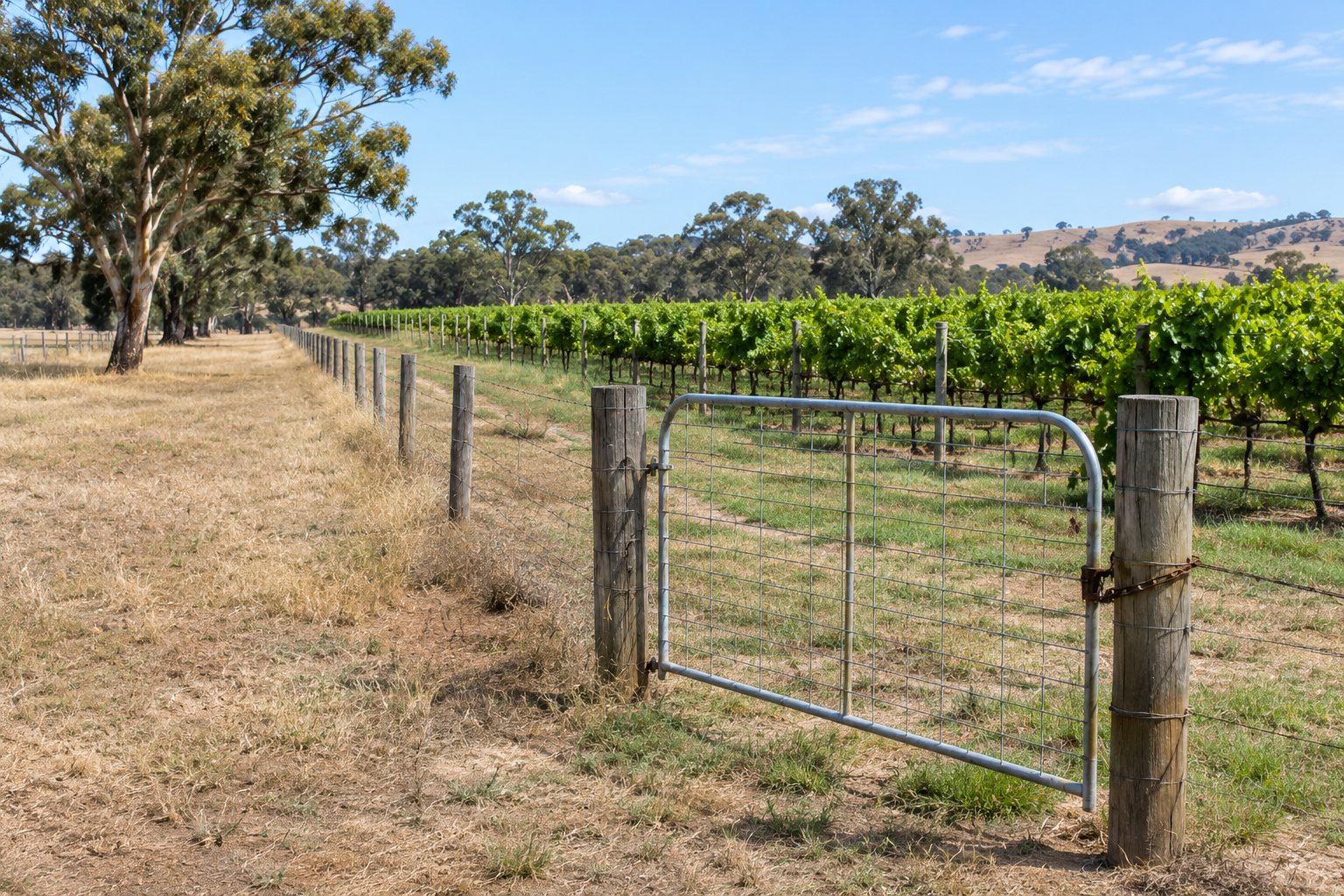
Section 6 sets the regard to be had in deciding whether a dividing fence is "a sufficient dividing fence". We do not summarise its subsections, because we captured only part of one. Justice Victoria is clearer for a landholder: the law "doesn't set a height or material", and "For rural properties, a sufficient dividing fence might be a wire and post fence." That is guidance, and the word "might" matters: you and your neighbour still need to agree on what is built. A neighbour who wants a higher standard pays the difference. The farm and stock fencing page describes what a post and wire fence is made of.
One Victorian council's page adds that a dividing fence "may sit off the common boundary line, for example where there is a waterway". That is council guidance, not a legal rule, so ask the council before you rely on it.
What the shared cost can include
Justice Victoria says shared costs can include design, clearing land, removing the old fence, surveying, approvals and temporary barriers. Damage caused by a neighbour is that neighbour's cost. The Act also includes a provision, s30H(1), that allows an owner to "recover half of the value of the existing dividing fence". We have not read its conditions in full, so read the section or ask Legal Aid Victoria before you rely on it. Section 19 allows a party to "commence fencing works and any subsidiary works without agreement" in the circumstances the section states, which you should read before relying on it.
Two special cases are in Justice Victoria's guidance. Urgent repairs, such as a falling tree, fire or flood, can proceed with an urgent fencing notice for a contribution. And if the owner cannot be found and you want a contribution, you need a Magistrates' Court order before work starts.
Crown land, roads and public land neighbours
On the Victorian side of the Murray, the Act may not apply if the neighbour is public land. Section 31 says the Act, with s30H, "shall not apply to any unalienated Crown lands". Justice Victoria says "Certain Crown land is exempt from fencing contributions", and that councils or bodies managing public parks and reserves "are not treated as owners". The DEECA fencing factsheet (August 2024) says the government is not liable for any maintenance, or contribution towards fences that adjoin Crown land under the Fences Act 1968 (DEECA fencing factsheet).
A Victorian council goes wider, saying the Act "may not apply where the land adjoins Crown land, roads or laneways, or other authorities' land, such as Goulburn Murray Water or VicTrack". Separate bushfire repair support exists for agricultural land bordering national parks, State parks and State forests: ask DEECA for the current terms. Crown water frontages and clearing vegetation for a fence are on the Murray page.
A fence along the river, or across it
The Murray is the state border. A dividing fence is between neighbours' lands on the same side, and the Act that applies is the one for the state where the fence is. On the Victorian side of the Murray, that is the Fences Act 1968. We say no more than that. No source we found says what the Act does for a fence along or across the river, or between a Victorian owner and an owner on the other side. If your boundary is the river itself, or your neighbour is across it, ask Justice Victoria, Legal Aid Victoria or a solicitor.
On where the line is, Wikipedia, a secondary source, says the border lies along the top of the southern (Victorian) bank (Murray River). Victorian and New South Wales survey agencies inspected the river at Mildura between the George Chaffey Bridge and the downstream weir and agreed "the precise line of the border" in September 2022, with formal survey and marking still to follow (border survey update, Spatial Source).
Local pages and what to do next
The same Victorian rules apply across Mildura, Merbein, Nichols Point and Cardross, Red Cliffs and Irymple, Robinvale and Ouyen and the Mallee. Whether the contractor needs a licence or registration is a separate question, and the licensing page explains what the regulator pages say. When you are ready, send your town, a photo of the fence line and who your neighbour is.
What this page cannot do
This page cannot tell you who pays for your fence, whether your fence is sufficient, or whether a section of the Act applies to your land. It describes the Act and the guidance in the version we found, and it stops where our sources stop: the Murray as a boundary, section 6 in full, and the conditions of sections 19 and 30H. We are not lawyers, and we are a referral service. We pass your enquiry to local contractors, who build the fence. For a dispute with a neighbour, the Dispute Settlement Centre Victoria, Legal Aid Victoria and a solicitor are the right people.
Check the current rules before you rely on this
This page describes boundary fence rules on the Victorian side of the Murray under the Fences Act 1968, in the version we found. It describes the rules in general terms as they stood in November 2026. Standards, forms, thresholds and fines change.
The authoritative sources are Fences Act 1968 (Vic), authorised version 072, amendments as at 29 March 2021 (FAOLEX copy), Justice Victoria, fences: your rights and obligations, Dispute Settlement Centre Victoria, fencing disputes: steps, Legal Aid Victoria, fences and trees and Swan Hill Rural City Council, boundary fencing. Where anything here differs from those sources, they are right and we are not.
We are not fencing contractors, builders, regulators or lawyers. For what applies to your fence, ask Justice Victoria, the Dispute Settlement Centre Victoria or Legal Aid Victoria. A fence on the other side of the Murray comes under a different Act, which our New South Wales page covers.
Accurate at the time of writing, November 2026. Always check the source before relying on it.